


North America
Europe
Asia Pacific
Middle East
South Africa
South America
Executive Summary
The global ocean freight market is entering June 2026 in a firm but fragmented position. Container spot rates are rising again on Asia–Europe and Transpacific trades, driven by early peak-season demand, FAK increases, PSS announcements, selective blank sailings, and Middle East disruption. Drewry’s WCI rose 6% to USD 2,712/FEU on 21 May, while Shanghai–Rotterdam climbed 15% w/w to USD 2,773/FEU and Shanghai–Genoa rose 10% to USD 4,082/FEU.
Operationally, the core issue is not only price but execution: Hormuz-linked rerouting has stabilized but created severe dwell and congestion, especially around the newly established gateways. Especially for out of gauge cargo, the new corridors are not really workable and we see massive delays.

LET US KNOW YOUR OPINION
How do you like our Market Reports? Fill in our survey (it only takes a minute) to share for feedback and gain even better market insights in the future.
Project and breakbulk cargo remain more stable than containers but face longer lead times, fuel risk, and port constraints.
Global Economic & Trade Context
The macro backdrop is now dominated by energy shock, geopolitical routing risk, and protectionist trade policy. The UN cut its 2026 global GDP growth forecast to 2.5%, down from 2.7%, and warned of a downside scenario near 2.1% if the Middle East crisis worsens. It also raised its 2026 inflation expectation to 3.9%, explicitly linking the revision to higher energy, refinery-product, transport, and import costs.
Trade policy remains another drag on planning certainty. UNCTAD’s 2026 trade outlook highlighted rising tariffs, especially in manufacturing, and warned that frequent policy shifts discourage investment and disrupt supply chains. It also noted that nearly two-thirds of global trade moves within value chains now being reshaped by geopolitics, industrial policy, and technology-led relocation.
For shippers, the implication is blunt: procurement decisions cannot be based on base ocean freight alone. Energy surcharges, emergency contingency fees, inland substitution, detention exposure, and insurance wording are now decisive margin factors.
Container Freight Market Analysis
Spot Rate Developments
|
Index / Lane |
Latest public figure |
Direction / interpretation |
|
Drewry WCI composite |
USD 2,712/40ft, 21 May |
+6% w/w, third weekly increase in May |
|
Xeneta FE–USWC |
USD 2,884/FEU, 13 May |
Flat-to-firm; +2% over prior month |
|
Xeneta FE–USEC |
USD 3,974/FEU, 13 May |
+2% over prior month |
|
Xeneta FE–N. Europe |
USD 2,531/FEU, 13 May |
-8% over prior month before late-May rebound |
|
Xeneta FE–Med |
USD 3,451/FEU, 13 May |
-12% over prior month before late-May rebound |
Xeneta’s 13 May data showed the market split clearly: Transpacific rates had plateaued at elevated levels, while Europe-bound trades had softened from April highs as alternative routing and landbridge workarounds absorbed part of the initial shock. Far East–USWC remained more than 50% above pre-conflict levels, while Far East–Mediterranean was only 4% above pre-crisis at that point.
Drewry’s 21 May update shows that the softening phase is ending, at least temporarily. Asia–Europe rates moved sharply upward on early peak-season cargo, higher FAK levels, and carrier pricing discipline. Drewry also reported only three blank sailings on Asia–Europe for the following week, suggesting carriers are deploying enough capacity for demand but still pushing price levels through FAK and PSS mechanisms.
Carrier strategies:
Carrier behavior is now focused on four levers:
- FAK increases: CMA CGM announced new FAK levels effective 1 June at around USD 4,700/FEU Asia–Europe and USD 5,500–5,700/FEU Asia–Mediterranean, above late-May spot levels.
- PSS implementation: ONE announced a USD 2,000/FEU Transpacific eastbound PSS effective 1 June, while Maersk’s May update lists a Far East Asia to US/Canada PSS announcement dated 18 May.
- Selective blank sailings: Drewry counted seven blank sailings on Transpacific for the following week, creating room for higher FAK rates.
- Emergency and fuel surcharges: Maersk’s May advisory list includes changes to Emergency Contingency Surcharge for Upper Gulf countries and Middle East operational updates, reflecting the move from pure freight pricing to risk-adjusted cost recovery.
Breakbulk & Project Cargo Segment
Breakbulk and project cargo remain structurally firmer and less index-driven than container freight. Bertling’s April baseline expected the segment to stay comparatively stable, with firm pricing on specialized energy and industrial flows.
Drewry’s updated Breakbulk Sea Transport Indices now separately track Project Cargo and General Cargo, using January 2019 as the base point and incorporating time-charter rates for project cargo carriers, general cargo ships, small feeders, handysize dry bulk, car carriers, and relevant dry container rates.
Current market characteristics:
- Demand: Energy, infrastructure, mining, industrial plant, and renewable-related cargo continue to support heavy-lift and MPP demand. Middle East and Gulf uncertainty is delaying some execution, but not eliminating underlying project pipelines.
- Rates: Less volatile than container spot rates, but bunker exposure, war risk, port waiting time, and special equipment availability are pushing all-in pricing upward. Vessel operating cost heavily increased.
- Lead times: Longer than in Q1. Forwarders should assume earlier carrier engagement for heavy-lift, OOG, RoRo alternatives, and engineered transport.
- Comparison with containers: Containers are more volatile and index-reactive; project cargo is more stable but operationally less forgiving. Once engineering, permits, and vessel windows are committed, late changes become expensive.
Regional Insights – Deep Dive
|
Region |
Main trend |
Biggest bottleneck |
Freight-rate / trade-flow impact |
|
North America |
Demand mixed; Transpacific spot levels firming into early peak season |
USWC terminal processing and Transpacific blank sailings |
Asia–US rates remain elevated; importers delaying annual contracts keep more cargo in spot market |
|
Europe |
Asia–Europe rebound after mid-May softness |
North Europe yard density and Mediterranean routing uncertainty |
Shanghai–Rotterdam and Shanghai–Genoa rising again; higher June FAK levels expected |
|
Asia |
Stable intra-Asia, disrupted long-haul planning |
Southeast Asia transshipment pressure, bunker cost, Middle East routing |
Long-haul bookings require earlier planning; Asia export rates upward into June |
|
Middle East |
Severe Gulf disruption despite partial tactical stabilization |
Jebel Ali / Abu Dhabi dwell, Hormuz risk, landbridge limits |
Upper Gulf capacity constrained; emergency surcharges and alternative routing premiums persist |
|
South Africa |
Cape routing increases strategic relevance |
Durban / Cape corridor pressure, bunkering and transshipment flow |
Higher vessel calls and longer transit support port activity but raise congestion exposure |
|
South America |
Less directly disrupted but exposed to bunker and network repositioning |
Equipment imbalance and longer east–west rotations |
Rates less explosive than Gulf trades but surcharges and schedule variability rising |
Ocean freight trends - North America
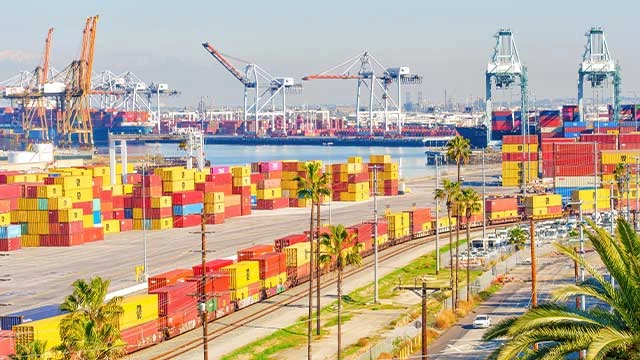
Maersk’s May North America update reports Q1 global container demand growth of 3–5% y/y, with North American imports slightly negative while Transpacific demand has increased. Maersk also notes that USWC gateways, especially Los Angeles-linked volumes, remain a watchpoint for extended terminal processing times.
Rate impact: Transpacific is firm but not overheated. The main risk is a late contract-signing cycle pushing cargo into the spot market, reinforcing rate stickiness.
Ocean freight trends - Europe
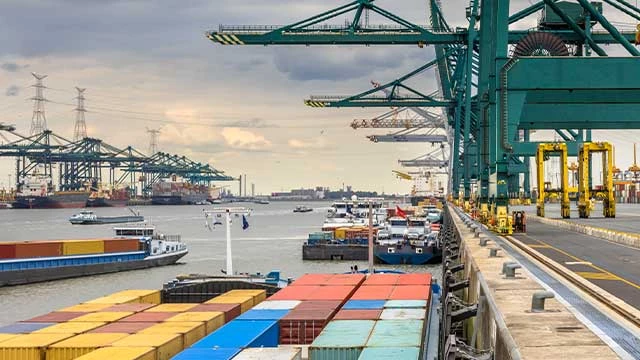
Europe faces a combination of Asia–Europe FAK increases, yard-density pressure, and energy-cost exposure. Maersk reported increased yard density at Antwerp, Bremerhaven, and Hamburg and asked customers to retrieve import units quickly after discharge. It also noted constrained conditions around the Strait of Hormuz and contingency planning for vessels transiting the region.
Rate impact: Europe-bound rates are likely to rise into June, especially if announced FAK levels stick.
Ocean freight trends - Asia
The Asia shipping market remains stable but cautious. Moderate US and European demand and pre–Q3 inventory restocking are offset by vessel oversupply, pressuring utilization and rates. Carriers are managing capacity to limit declines. Geopolitical risks and trade policy shifts continue to drive volatility. Overall, the market is balanced between overcapacity and disruptions, creating a stable yet sensitive environment.
Operational Pressure Points

- Middle East tensions keep insurance, fuel, and operating costs high.
- Schedule reliability remains below normal due to rerouting and network changes.
- Equipment shortages persist in some Asian export markets, especially specialized units.
Impact on Asian Ports
- Red Sea avoidance is extending transit times and disrupting schedules.
- Key hubs (Singapore, Ningbo, Zhoushan, Port Klang, Tanjung Pelepas) face periodic congestion.
- Feeder disruptions affect regional cargo connections.
Rate impact: intra-Asia remains more resilient, but long-haul Asia exports are exposed to bunker, equipment, and transit-time premiums.
Freight Rate Outlook
- Rates are stable overall but volatile by trade lane.
- Asia–Europe supported by longer routes and costs, but limited by weak demand.
- Transpacific under pressure from excess capacity and cautious US demand.
- Intra-Asia mixed, driven by local demand and congestion.
- Near term: rates likely range-bound, with carriers managing capacity to offset oversupply.
Ocean freight trends - Middle East
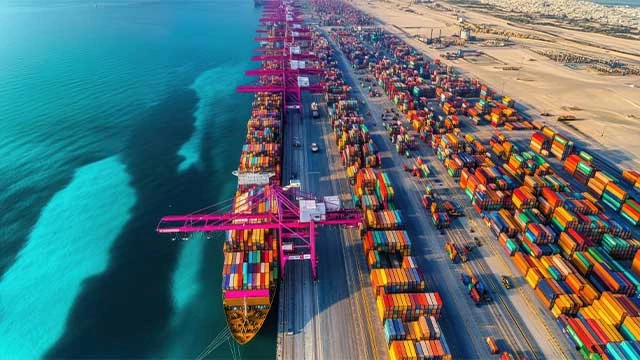
This is the most disrupted region, especially for OOG cargo and project cargo. Alternative routings are not working in a standardized process.
Rate impact: Middle East cargo should be priced as a controlled-risk shipment, not a standard FAK move. Space, dwell, detention, inland handover, and insurance must be quoted explicitly.
Ocean freight trends - South Africa
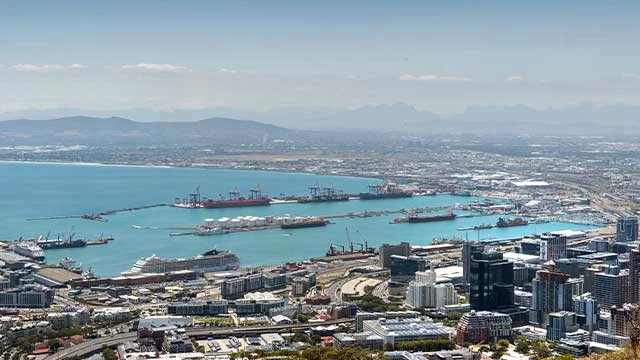
Cape routing remains elevated. Project44 reported Durban handling 76,151 TEU arrivals and 72,336 TEU departures in Week 11, both above pre-conflict weekly averages.
Rate impact: South Africa benefits from increased routing relevance, but Durban and regional ports remain exposed to bunching, berth pressure, and schedule knock-on effects.
Ocean freight trends - South America
The current market situation (last 20 days) between Asia and South America, mainly ECSA, has been heavily impacted by tariff increases.
Rate impact: South America is not the epicenter of disruption, but it is affected through bunker costs, vessel repositioning, and carrier network prioritization. Santos VLSFO was listed at USD 833/MT on 22 May, close to Houston and Singapore but still part of a high global fuel-cost environment.
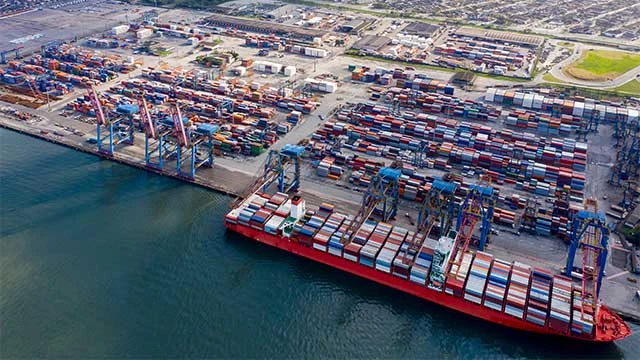
Maersk announced PSS increases from Far East Asia to East Coast South America, effective 4 June 2026. CMA CGM announced USD 1,000/container PSS from Asia to ECSA from 20 June 2026. Hapag-Lloyd also announced PSS from Far East to WCSA/ECSA/Mexico/Central America/Caribbean effective 15 June 2026.
Operational Insights
Port congestion and waiting / dwell times
The key operational shift is from immediate shock to embedded congestion in different ports, especially in the middle east region. The network has stabilized at a disrupted level rather than normalized, but especially for project and OOG cargo situation is still extremely difficult in certain areas.
Bunker fuel and surcharge implications
Bunker costs remain high and uneven. On 22 May, published bunker references showed VLSFO at USD 842/MT Houston, USD 832/MT Singapore, USD 766/MT Rotterdam, USD 910/MT Fujairah, USD 1,004/MT Los Angeles, and USD 879/MT Hong Kong. MGO was materially higher, including USD 1,522/MT Fujairah and USD 1,359/MT Los Angeles.
Implications:
- Emergency bunker and fuel recovery clauses will remain active.
- Fujairah-linked pricing remains a risk premium area.
- Cape routing adds voyage days and fuel burn, reinforcing surcharge stickiness.
- Forwarders should validate whether carrier quotes include MFR/BAF/EFS/ECS or treat them as floating.
Market Outlook & Strategic Recommendations
Short-Term Forecast: Next 1–3 Months
Base case for June–August 2026: container rates firm further into June, especially Asia–Europe and Transpacific, before stabilizing if peak-season demand is moderate and long-term contracts reduce spot exposure. We expect rates to increase in coming weeks due to higher FAK/PSS levels, tighter Transpacific capacity, early peak-season cargo, and elevated bunker/geopolitical cost pressure.
Upside-rate scenario: renewed Hormuz escalation, further bunker spikes, or broader Suez avoidance would push Gulf, Asia–Europe, and Mediterranean premiums materially higher.
Downside-rate scenario: if long-term contract volumes return to the market quickly and carriers deploy capacity aggressively, Transpacific spot rates could soften gradually, consistent with Xeneta’s view that delayed contract cargo will eventually move back from spot to contract.
Operational forecast: reliability improves only slowly. Even if rates stabilize, congestion, dwell, and inland bottlenecks will lag for additional 6-10 weeks.
Recommendations for shippers
- Prioritize execution quality over lowest FAK. Reliability, port pair, transshipment risk, and terminal dwell are now worth charging for.
- Pre-book peak-season allocations. June GRIs/PSS are already announced; late bookings will be exposed to roll and premium-rate risk.
- Lock vessel and engineering windows earlier. Treat heavy-lift capacity as scarce even where headline demand appears stable.
- Avoid over-reliance on Gulf gateways. Assess Sohar, Khor Fakkan, Jeddah, India, and overland alternatives case by case.
- Price port time realistically. Dwell and berth uncertainty can destroy project margins faster than ocean freight variance.
- Offer contingency concepts as a paid value-add. Customers need routing optionality, not only a freight rate.
Key Takeaway
The May 2026 ocean freight market is not a classic demand-led rate boom. It is a risk-led pricing environment: carriers are using FAK, PSS, blank sailings, and emergency surcharges to recover network disruption, bunker cost, and peak-season exposure. Forwarders that manage only rate levels will lose margin; forwarders that manage allocation, timing, dwell, surcharges, and customer communication will outperform.
Customer Advice
- Let's closely monitor the developments in the US trade policy and the impending world events to manoeuvre potential challenges effectively in the logistics industry.
- Think ahead and book well in advance. Try to plan for 6 months ++.
- Consider that the market can change significantly. Further disruptions can happen anytime.
- Identify contract options that enable flexibility and resilience for your business.
- Plan 3–4 weeks in advance for all Asia-related cargo.
- Consider alternative European gateways or routings where feasible.
- Maintain flexible delivery schedules to absorb delays.
- Stay engaged for tactical rate and space guidance.
However, it is our job at Bertling to keep global supply moving and do all we can and apply our knowledge, network and expertise to protect our clients’ while taking the latest market developments into account. We are there to find the best solutions to ensure cargo flows.


