


We would like to update you on significant developments affecting global ocean freight markets and supply chain planning.
Container shipping rates have risen sharply in recent weeks as importers accelerate shipments ahead of potential new U.S. tariff measures. According to market benchmarks, the Drewry World Container Index has climbed to approximately USD 4,200 per FEU, the highest level since September 2024 and roughly 40% above the same period last year. The Shanghai Containerized Freight Index (SCFI) has more than doubled year-on-year, reflecting strong demand and tightening capacity on key trade lanes. (maritime-executive.com)
What is driving the increase?
The current market is being driven by a combination of factors:
- Front-loading of shipments by U.S. importers seeking to avoid possible tariff increases.
- Strong export demand from Asia, particularly on Trans-Pacific routes.
- Constrained vessel and equipment availability on several major trades.
- Ongoing geopolitical and network disruptions affecting global shipping schedules and transshipment hubs (maritime-executive.com)
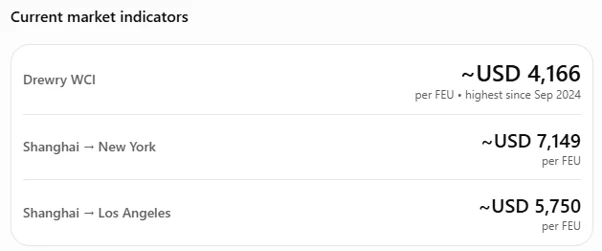
These levels indicate that capacity remains tight and that carriers are successfully implementing higher market rates and surcharges. (https://www.drewry.co.uk/)
Potential impacts on supply chains
Customers may experience:
- Higher ocean freight costs and peak season surcharges.
- Reduced space availability on preferred sailings.
- Longer booking lead times and increased rollover risk.
- Greater schedule variability across ocean and inland networks.
- Additional pressure on warehousing and drayage planning as cargo arrivals become less evenly distributed.
Our response
Our global operations teams are actively monitoring carrier capacity, sailing reliability, and market pricing. We are working with carrier partners to secure space and evaluate alternative routings where appropriate in order to minimise disruption to customer supply chains.
Client advice
To help reduce exposure to current market volatility, we recommend that customers:
- Book earlier than usual to secure vessel space and equipment.
- Review inventory positions and consider advancing time-sensitive shipments where commercially appropriate.
- Build additional lead time into production and transportation planning.
- Remain flexible on routing, carriers, and sailing dates where feasible.
- Discuss medium-term capacity requirements with your account representative so that allocation options can be assessed in advance.
- Review freight budgets and landed-cost assumptions to account for potential rate increases and surcharges through the coming peak season.
We will continue to provide updates as tariff timelines and freight market conditions evolve. If you require assistance with upcoming shipments or capacity planning, please contact your usual account manager or local customer service team.
More information will be shared in our June Market Reports, which will be available later this week.